
Is your problem a quantum problem? How to tell, and when AI or classical simulation is the better answer
The question we hear most often in first meetings with industrial R&D teams is which approach a hard problem calls for: quantum computing, AI, or the classical simulation the team already runs. AI and classical simulation run on high-performance computing (HPC), and quantum computers are being connected to the same HPC environments as accelerators, so the choice is between methods.
A common first step is a list of application areas where quantum computing might help, such as chemistry or fluid simulation, followed by a request to the business units for hard problems. “I have heard more than once that the request came back empty,” says Jakob Rosenkrantz de Lasson, Head of Business Development at QunaSys Europe.
A more useful starting point is a problem the team already has. Karim Essafi, Director of Research and Technology at QunaSys Europe, uses a set of questions for exactly this. Most of what follows is built on them.
Quick read
Write down six things for one problem you already struggle with:
- Which decision is a calculation holding up?
- Which number drives that decision?
- How accurate does it need to be?
- What do you run today, and what does one run cost?
- What can you share with an outside expert?
- What would a first pilot have to show?
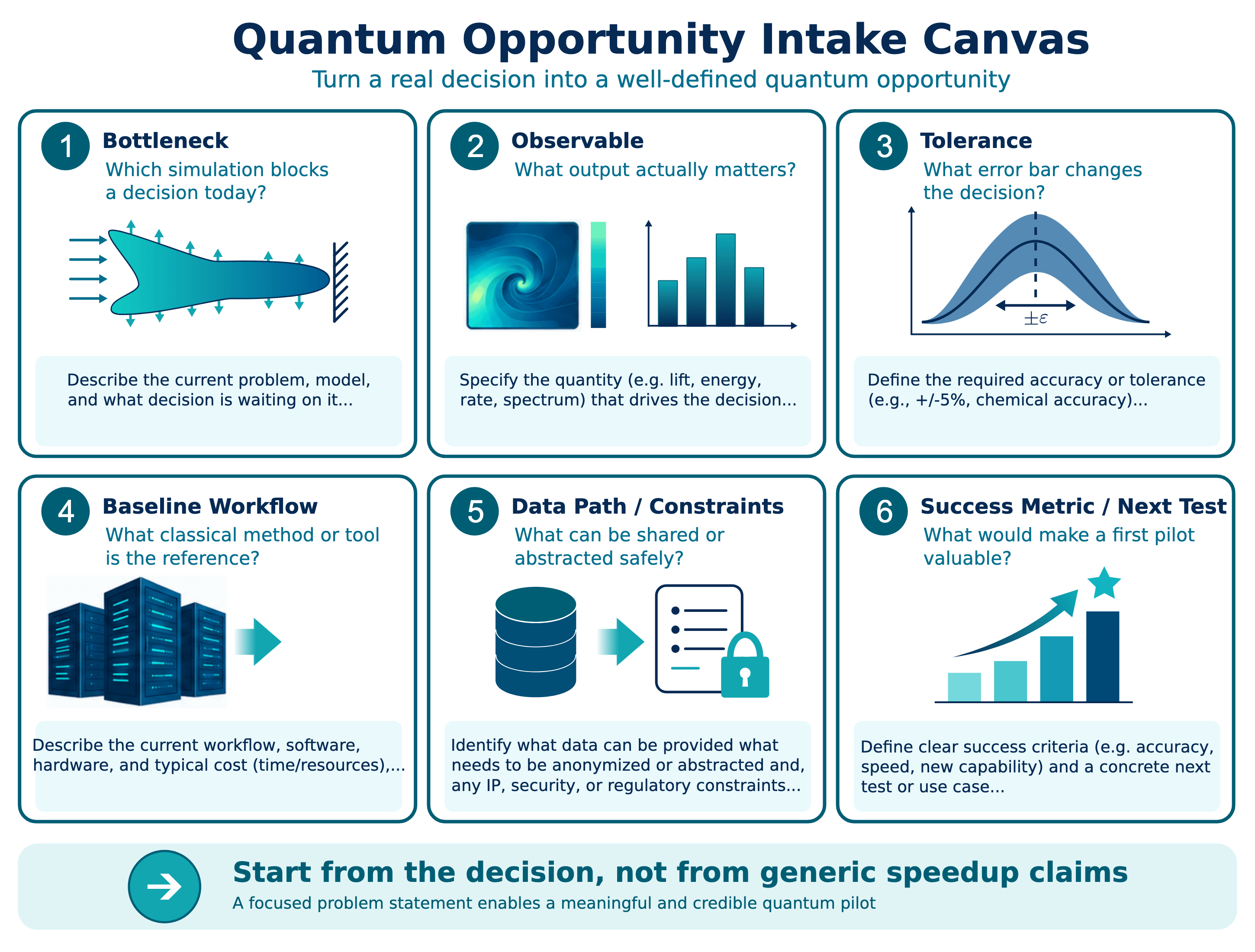
Quantum Opportunity Intake Canvas
If today’s methods already give good enough results, stay with classical simulation. If the problem is about learning from data, look at AI first. Quantum computing deserves a closer look when one step, set by the problem’s mathematical or physical structure, limits the whole calculation.
Start with the decision the result would change
Karim Essafi’s first question is which output of a calculation is valuable enough to justify a new way of computing it. Engineers already work around limited computing budgets. They use a coarser grid, leave out physics such as turbulence, test fewer design variants, or accept slower iteration. Each of these trades accuracy against cost and time.
That is where he sees the opening. “Quantum opportunity starts only where those trade-offs block a valuable decision,” he says. Ranking two designs or tightening a safety margin are typical examples. If no such decision exists, faster computing of any kind changes little, and the choice between technologies can wait.
The question also fixes the comparison. Industrial teams judge a new method against the classical methods they already run on their own computers, so a quantum method has to beat that baseline on the same output and at the same accuracy. A speed-up measured against a weaker reference tells them little.
When classical simulation is enough
Often the answer is the classical simulation the team already runs. If today’s trade-offs, such as a coarser grid or a simplified model, still give results good enough for the decision at hand, there is nothing for a new method to fix. The same holds when a problem only needs more computing time and its cost does not explode as it grows: more hardware or a better classical algorithm will usually close that gap sooner and at lower risk. Classical methods also keep improving, so the bar a quantum method has to clear rises every year.
AI or quantum: where is the bottleneck?
AI is usually the stronger choice when a problem is about learning from data, such as predicting a formulation’s properties, spotting a fault in sensor readings, or estimating the next simulation result from past runs. “I would not frame this as ‘large datasets means AI’, because that is too simplistic. The type and structure of the data matter as well,” says Karim Essafi. “AI is usually attractive when the problem is fundamentally about learning a mapping from data, whereas quantum is more natural when the bottleneck comes from the underlying mathematical or physical structure.”
Examples of the second kind include large, structured systems of linear equations, data produced by quantum systems, and strongly correlated materials, in which electrons interact so strongly that standard classical approximations break down.
Structure matters for a practical reason too. Before a quantum computer can process classical data, that information must be encoded into a quantum state, a process known as quantum state preparation. Depending on the problem, this step can account for a significant part of the computational cost. Extracting the final result from the quantum computer also introduces costs that must be considered. An advantage is also more plausible when the decision depends on a few numbers, such as the drag on a component, than when it needs a value at every point of a simulation grid.
“It is not necessarily an either/or choice,” Karim Essafi adds. Quantum machine learning (QML) and quantum physics-informed neural networks (QPINNs) are also being explored as ways to combine quantum computing with AI, including approaches that incorporate physical laws into the learning process.
Many teams sit in between, with too little data for a reliable AI model, often because reference data from experiments is scarce and expensive. Then the first task is to produce more data, by measurement or by simulation. A simulation specialist may be the right first call even when the end goal is an AI model.
What a quantum candidate looks like
A good candidate has one step that dominates the cost of the whole calculation and grows too fast for classical computers as the problem gets bigger. In engineering simulation, that step is often solving very large systems of equations, such as those describing fluid flow, heat transfer or vibration in a component. When these systems have mathematical structures that quantum algorithms can exploit, they offer a promising route to tackling computational bottlenecks that are difficult to overcome with classical methods.
A researcher at Mitsubishi Electric, which has developed quantum algorithms for engineering simulation with QunaSys, has described the realistic setup: break a large calculation down, leave most of it to classical computers, and hand only the heaviest matrix calculation to the quantum computer as an accelerator. Where a model lacks such structure, he expects classical computing to remain the better choice.
The goal is to integrate quantum computers into existing HPC workflows as specialised accelerators. Classical HPC handles most of the calculation, including preparing the problem and processing the results, while the quantum computer tackles the computationally demanding steps where it can offer an advantage. “On the quantum side, it will be HPC-quantum,” as Karim Essafi puts it. A realistic first milestone is that step running inside a validated workflow, set up on the same geometry, physics, output and error tolerance as the classical method. Outperforming the classical method is the longer-term goal.
Six things to write down before you ask for outside help
These are the six questions from the quick-read box in full. Karim Essafi proposes them as a short intake form that turns a vague interest in quantum computing into a problem that someone can assess.
- Which simulation or calculation is holding up a decision, and what is the decision?
- Which quantity drives that decision, for example lift, energy, a reaction rate or a spectrum?
- What accuracy would change the decision, for example ±5% or chemical accuracy?
- Which classical method, software and hardware do you use today, and what does one run cost in time and resources?
- What can you share, what has to be anonymised or simplified, and which IP, security or regulatory limits apply?
- What would a first pilot have to show to be worth it: better accuracy, more speed, or something you cannot do today?
With these written down, a team has what it needs to discuss the problem with a quantum, AI or simulation specialist. Point five often worries teams. A first assessment usually needs a description of the problem’s structure and size, and rarely the company’s own data.
What these questions cannot settle
The six points narrow the field. They cannot tell whether a specific problem will benefit from quantum computing, or when. That takes a resource estimate: a calculation of how many error-corrected qubits and how much run time the problem would need, set against hardware roadmaps. Such estimates often find the hard part outside the core algorithm, in loading data, reading out the answer or keeping the numerical method stable over a long simulation.
Resource estimation is how a team decides which workflows are worth preparing for. For most teams, the practical first step is smaller: fill in the six points for one problem they already struggle with, and see which way it points.
Sources
- Karim Essafi, “From Industrial Bottlenecks to Quantum Opportunities”, QunaSys workshop at the Niels Bohr Institute, Copenhagen, 24 September 2026
- Quantum CAE interview with Mitsubishi Electric, MONOist (in Japanese), September 2026
Contact
To discuss whether your problem is a quantum problem, please get in touch with our team.