
When Engineering Simulation Hits a Wall: A New Kind of Computer Offers a Way Forward
Modern engineering runs on simulation. Before an aircraft component is manufactured, its aerodynamics have been modeled millions of times on a computer. Before a gas pipeline is built, engineers simulate fluid flow through every segment to optimize pressure and throughput. Before an electric vehicle battery is finalized, thermal simulations predict how it will perform under extreme conditions.
This kind of simulation, broadly called computational fluid dynamics, or engineering simulation, is one of the most computationally demanding tasks in industrial R&D, and it is approaching a ceiling.
The problem with “good enough”
Engineering simulation works by dividing a physical system into a grid of tiny cells and solving equations for each one. More cells mean higher accuracy, but the computational cost grows rapidly. For many real-world problems, such as full-resolution turbulence in an engine, multi-physics interactions in a chemical plant, or real-time optimization of a manufacturing process, the number of cells required exceeds what even the largest supercomputers can handle in a reasonable time.
Engineers cope by using approximations. Think of a boulder rolling down a hill. You could model it as a perfect sphere on an even slope and get an answer in seconds. Or you could try to account for every blade of grass, every gust of wind, and the exact shape of the boulder, and get a near-perfect answer that takes so long to compute it is useless in practice. Real engineering simulation lives in the tension between those two extremes: the goal is always to balance accuracy against cost. They simplify the physics, coarsen the grid, or focus on a small region of the system. These trade-offs work well enough for many applications, but they impose a hard limit on the accuracy and scope of what simulation can predict. For the most demanding problems, the ones that would unlock the next generation of products, “good enough” is no longer good enough. For now, accuracy and cost pull in opposite directions. A new kind of computer may be about to loosen that constraint.
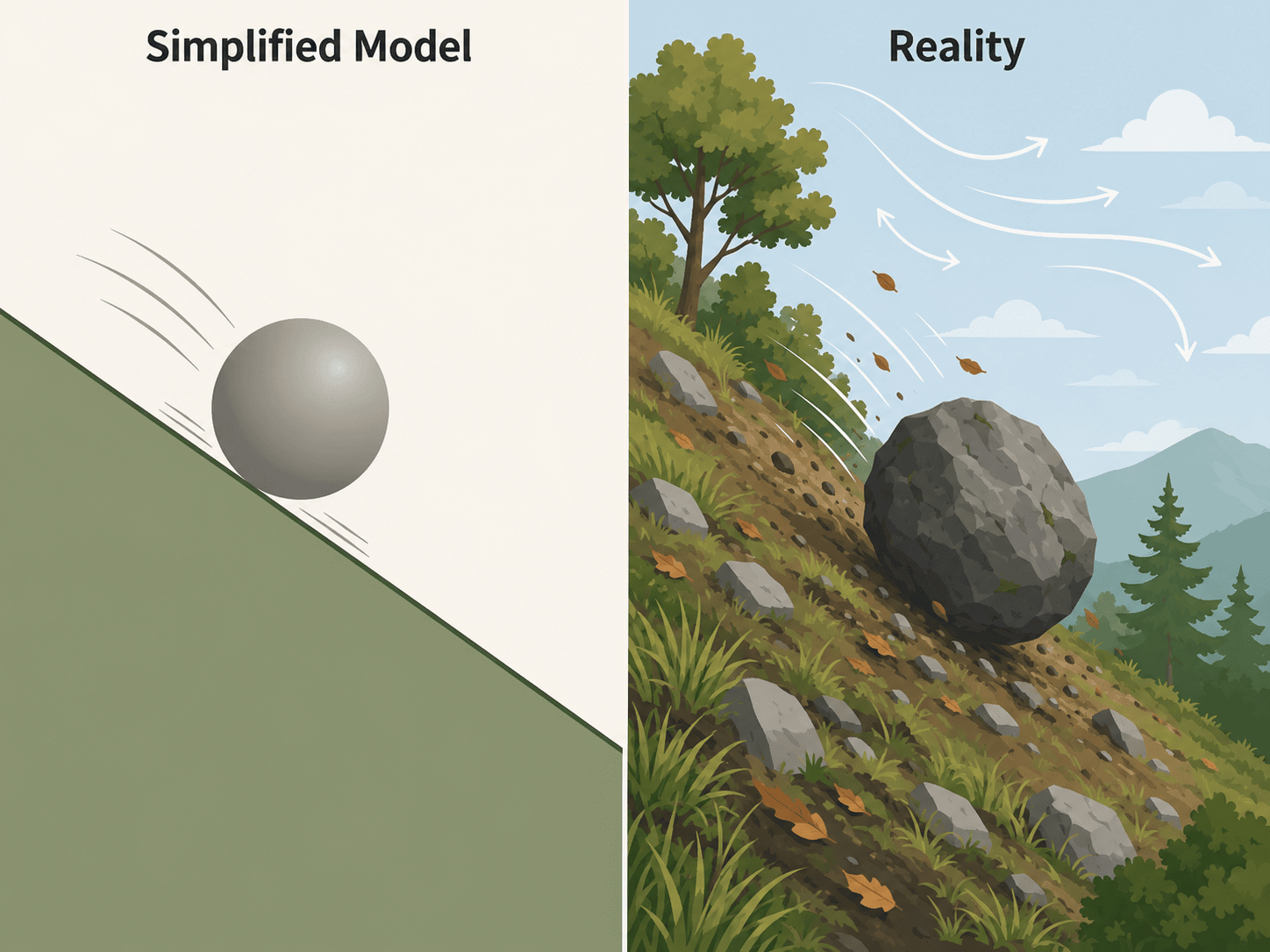
Simplification vs. reality: the accuracy-cost trade-off in engineering simulation
A fundamentally different approach
Quantum computers process information using the principles of quantum mechanics, which govern how fluids, heat, and particles actually behave at the physical level. This makes them potentially well-suited to simulation problems that overwhelm conventional computers.
The technology is still developing. Today’s quantum computers cannot yet replace conventional engineering simulation for most problems. However, they have reached the point where meaningful demonstrations are possible, and where companies can begin building the expertise and infrastructure they will need in the future.
Industries including aerospace, energy, and automotive have decided that now is the time to start.
Multiple approaches, one common strategy
What makes these partnerships notable is not just the technology, but how the companies are approaching it. Each has taken a different entry point, but all follow a common pattern: start small, prove value, then scale.
“To identify technical challenges early and ensure each new improvement can be integrated with confidence, small scale feasibility studies create the data needed to move forward with confidence. Here, by establishing strong scientific foundations and taking a modular approach to quantum engineering, the QunaSys team is able to continuously incorporate year-on-year advances in quantum technology,” says James Pegg, Research Scientist at QunaSys.
A national space agency began by running quantum-enhanced fluid simulations on one of the world’s most powerful supercomputers. The test used over two thousand computing nodes to model fluid flow on a large grid, a demonstration that quantum simulation methods can operate at the scale that aerospace engineering demands. The agency now runs six concurrent quantum simulation projects, each targeting a different class of engineering problem. The results have been presented at international conferences and shared with European research partners.
A major gas utility started with a simple question: can quantum computing improve the fluid simulations we use to design and operate pipeline networks? A focused feasibility study delivered a working prototype and a technical roadmap. The results were strong enough to justify a follow-on research contract with nearly three times the original budget, a clear signal of confidence. The study materials were later adapted for use with another energy infrastructure company, demonstrating how a single well-executed project generates value beyond the original engagement.
The IT arm of one of the world’s largest automotive groups has built the highest number of projects of any partner in this space. Their focus is on a mathematical approach that bridges the gap between traditional engineering design tools and quantum computation, essentially building a translation layer that allows engineers to feed their existing design files into quantum simulation workflows. This work feeds directly into the broader technology strategy of a major automotive conglomerate, connecting to efforts in materials science, component manufacturing, and vehicle engineering.
A major heavy electrical manufacturer took a different angle: rather than running simulations, they focused on answering the question that engineering leaders care about most: “When will quantum simulation actually outperform what we already have, and for which types of problems?” Their research on this question, presented at academic conferences, has drawn interest from organizations across multiple industries.
A leading automotive components supplier focused on community building. Instead of diving into deep technical work, they organized cross-industry workshops bringing together companies from energy, electronics, and automotive to share perspectives on quantum simulation. Monthly reviews and annual planning sessions are now standard practice, building organizational readiness alongside technical capability.
What has been achieved
The results at this stage are not about replacing existing simulation tools. They are about proving feasibility, building expertise, and establishing strategic position:
- A fluid simulation running on over two thousand supercomputer nodes demonstrated that quantum methods can operate at industrial scale, not just on textbook problems.
- A feasibility study delivered a working quantum simulation prototype that convinced a major utility to nearly triple its investment.
- A translation pipeline connecting traditional engineering design tools to quantum workflows was developed and extended to three-dimensional models.
- Published research on when quantum simulation will outperform classical methods is being used to inform investment decisions across multiple industries.
- Cross-industry exchanges created a community of companies sharing knowledge and building collective readiness.
Why this matters now
Engineering simulation is one of the clearest areas where quantum computing could deliver practical industrial value. The problems are well-defined, the limitations of current methods are well-understood, and the physics that quantum computers naturally model is the same physics that simulation needs to capture.
Companies that begin building quantum simulation capabilities now will have a significant head start when more powerful hardware arrives. They will understand which of their engineering problems benefit most from quantum approaches, they will have trained teams who can work with the technology, and they will have established the partnerships and funding structures needed to move quickly.
These industries are not waiting for a future that may or may not arrive. They are investing in a structured, phased process that delivers value today, through working prototypes, published research, cross-industry knowledge, and strategic roadmaps, while building toward the larger breakthroughs that quantum computing promises for engineering simulation.
For any company whose competitive advantage depends on the quality of its engineering simulation, the question is worth asking: what are your competitors learning right now that you are not?
Contact
To learn more about how quantum computing can advance your engineering simulation capabilities, please get in touch with our team.