
QunaSys Successfully Simulates a Quantum Circuit with Over 300 Million Gates Using NVIDIA cuQuantum and 1,024 GPUs
QunaSys Inc. (headquartered in Bunkyo-ku, Tokyo, Japan; Representative Director: Tennin Yan; hereafter “QunaSys”), a developer of software and algorithms for quantum computers, has successfully completed end-to-end validation of a quantum algorithm for quantum chemistry that is expected to be useful in fault-tolerant quantum computing (FTQC). The validation involved a quantum circuit with more than 300 million gates and covered the entire workflow, from circuit construction and compilation to execution and analysis of the results. To calculate molecular energies accurately using future fault-tolerant quantum computers, it is necessary to verify in advance that the entire workflow, from preparation and execution to measurement analysis, works as intended. However, simulating large quantum circuits on classical computers requires substantial computing resources, limiting the scale at which validation has been possible. QunaSys conducted a large-scale simulation of qubitization-based quantum phase estimation (QPE) using its quantum software development platform, QURI SDK Enterprise, and NVIDIA cuQuantum. The validation used 1,024 NVIDIA Hopper GPUs on ABCI-Q, the quantum-classical hybrid computing infrastructure operated by the National Institute of Advanced Industrial Science and Technology (AIST).
This quantum algorithm requires many auxiliary qubits and an enormous number of operations, making it computationally demanding to validate on classical computers. By optimizing the computational workflow and distributing the processing across many GPUs, QunaSys achieved the world’s largest end-to-end classical simulation of qubitization-based QPE in terms of both qubit count and gate count.† The results demonstrate that QURI SDK Enterprise can use high-performance classical simulation to validate the behavior and computational accuracy of FTQC software before practical quantum hardware becomes available.
† The largest among publicly available examples identified by QunaSys as of September 2026 for end-to-end classical simulation of qubitization-based QPE.
This research has been accepted for presentation in the Research Posters track at SC26, an international conference on high-performance computing to be held in Chicago, USA, from November 15 to 20, 2026.
Presentation title: Chemically Accurate End-to-End Classical Simulation of Qubitization-Based Quantum Phase Estimation on 1,024 GPUs.
Key Achievements
Large-scale quantum algorithms intended for future fault-tolerant quantum computers cannot yet be run on current quantum computers. Before suitable hardware becomes available, it is therefore important to use classical computers to verify that the complete algorithm works correctly and returns results with the expected accuracy. QunaSys validated the entire workflow, from circuit construction and compilation to execution and analysis of approximately one million measurement outcomes, and confirmed chemical accuracy for the ground-state energy of a four-hydrogen-atom model (H₄).
- Validation of computational accuracy with qubitization-based QPE: For a model consisting of four hydrogen atoms (H₄), QunaSys simulated a quantum circuit with approximately 319 million gates and generated approximately one million measurement outcomes in about 1.5 hours. The most frequently measured energy differed from the exact solution for the same molecular model by 0.53 mHa, meeting the benchmark known as “chemical accuracy.”
- End-to-end validation with QURI SDK Enterprise: QunaSys constructed and compiled quantum circuits for qubitization-based QPE and used NVIDIA cuQuantum to enable GPU simulation for verifying both the resulting energy values and how frequently each value was obtained.
- Larger-scale execution: With a relaxed error tolerance for molecular energy estimation, QunaSys expanded the target systems from two to ten hydrogen atoms and executed quantum circuits with up to 42 qubits.
Research Background
Understanding the properties of materials and catalysts requires knowledge of the energy of a molecule in its most stable state, known as its ground-state energy. Fault-tolerant quantum computers correct errors during computation and are expected to enable highly accurate calculations of molecular energies.
Qubitization-based QPE is one approach to calculating molecular energies. It encodes a mathematical model of a molecule’s properties into a quantum circuit and uses QPE to extract the energy. Bringing this approach into practical use requires more than estimating the number of qubits and operations needed. The full workflow, from preparing the computation to interpreting the results, must be tested to ensure that it works as intended. However, simulating an entire quantum circuit requires substantial memory and computation time, limiting the scale at which such validation has been possible.
Technologies Used for Validation
QURI SDK Enterprise was used throughout the workflow, from constructing quantum circuits based on molecular models to compilation, simulation, and analysis of measurement results. During circuit construction, QunaSys reduced the required qubit count and number of operations by improving how molecular models were encoded into quantum circuits and how the quantum states needed to initialize the computation were prepared. The resulting circuits were then compiled into a format executable by the simulation software.
NVIDIA cuQuantum served as the simulation backend for QURI SDK Enterprise. Distributing the data representing a quantum state across many GPUs enables the simulation of circuits too large to fit in the memory of a single GPU. Communication time was reduced by minimizing data transfers between GPUs and prioritizing the high-speed communication available between GPUs within the same compute node.
Validation Results
H₄ Circuit Size and Measurement Results
For QPE on H₄, circuit optimization reduced an initial configuration estimated at 99 qubits and approximately 1.78 billion gates to 28 qubits and approximately 319 million gates. Using 1,024 GPUs, the optimized circuit was simulated and approximately one million measurement outcomes were generated in about 1.5 hours.
Analysis of the measurement results showed that the most frequently measured energy differed from the exact solution for the same molecular model by 0.53 mHa, within the chemical accuracy benchmark of 1.6 mHa (Figure 1). In addition to the energy values, QunaSys analyzed the measurement distribution, which describes how frequently each value was obtained, confirming that the complete quantum circuit returned results with the expected accuracy.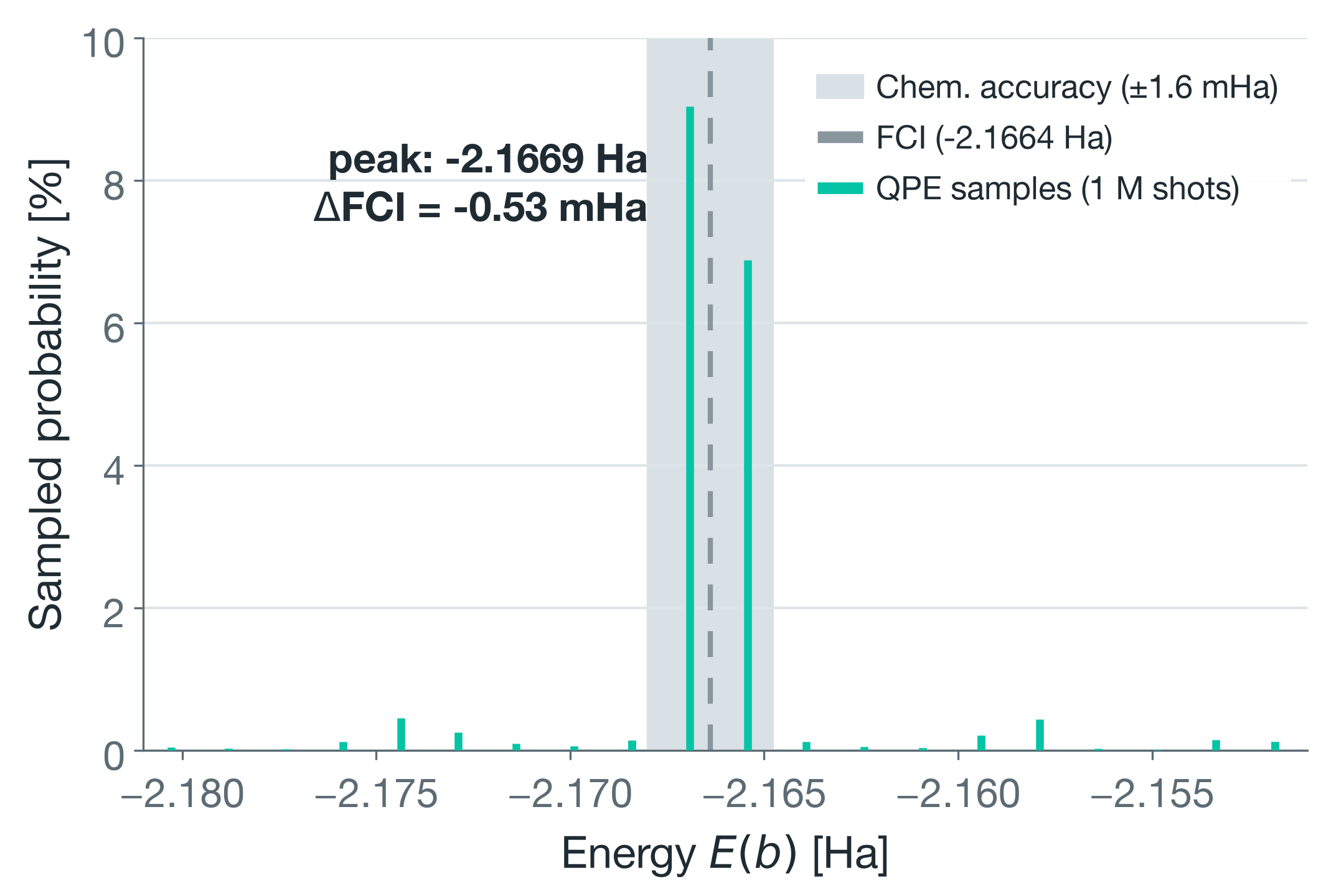
Figure 1: Measured energy distribution for H₄, showing a close-up around the exact solution. The green lines indicate the frequency of each energy value, the gray dashed line indicates the exact solution, and the shaded region spans ±1.6 mHa around the exact solution, corresponding to the chemical accuracy benchmark.
Execution of Circuits with Up to 42 Qubits
To assess how large a circuit could be simulated, QunaSys relaxed the error tolerance for energy estimation and tested hydrogen-chain models containing two, four, six, eight, and ten atoms. Under these conditions, a QPE circuit for H₁₀ with 42 qubits and approximately 490,000 gates was successfully executed. The study thus validated both circuits with large gate counts, using approximately 319 million gates for H₄ at chemical accuracy, and circuits with large qubit counts, using 42 qubits for H₁₀ with a relaxed error tolerance (Figure 2).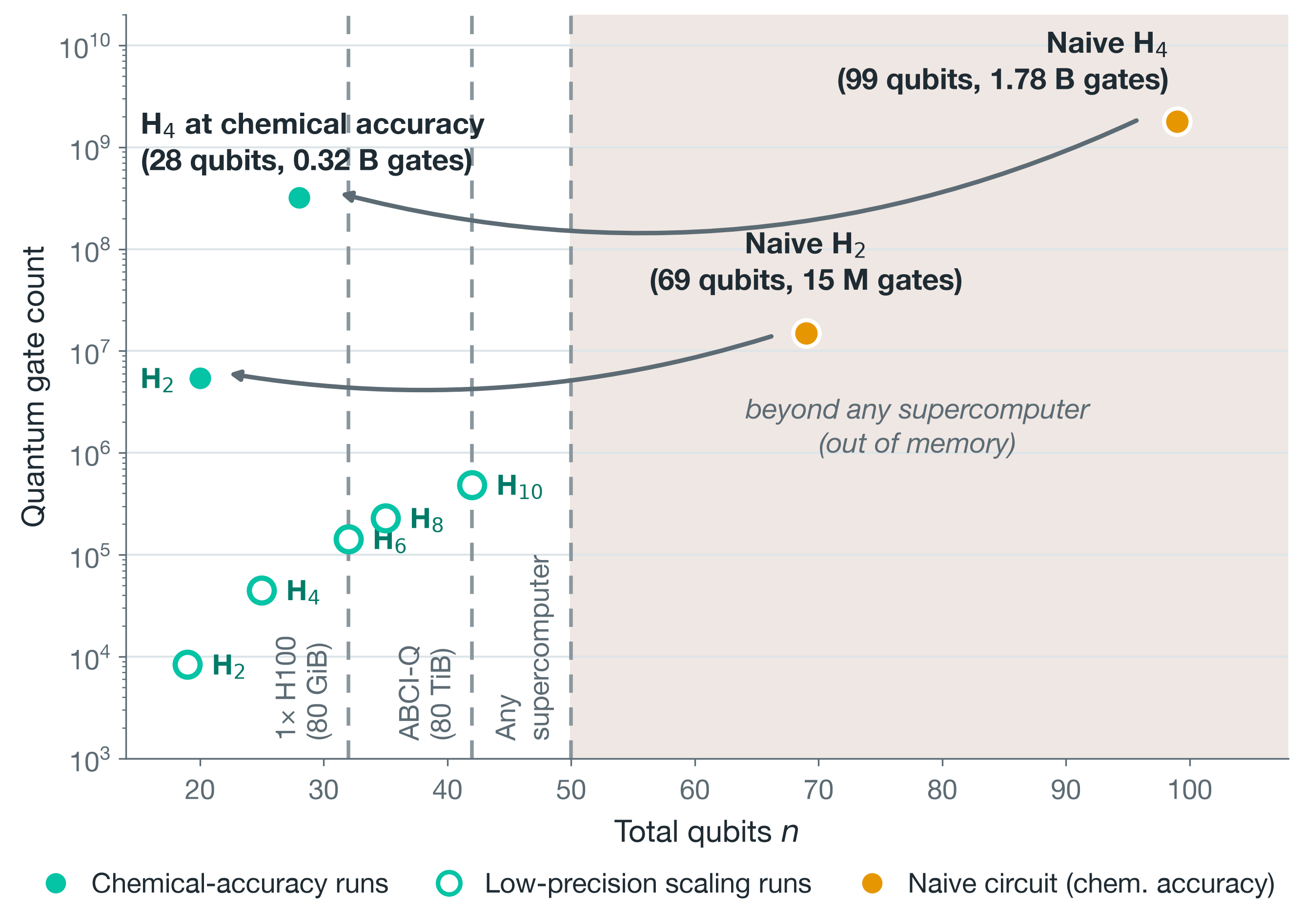
Figure 2: Quantum circuit sizes and the scope of validation. The horizontal axis shows the number of qubits, and the vertical axis shows the number of gates. Filled green circles represent H₂ and H₄ runs at chemical accuracy, while open circles represent H₂ through H₁₀ runs with a relaxed error tolerance. Orange circles show estimates for the initial configurations before execution, and arrows indicate reductions in circuit size through optimization. The vertical axis uses a logarithmic scale, and the vertical dashed lines indicate approximate memory limits.
GPU Count and Execution Time
Parallel performance across GPUs was evaluated using a 32-qubit QPE circuit for H₂. In a strong-scaling evaluation, where the computational workload was held fixed while the number of GPUs increased, execution time fell from approximately 4,155 seconds on one GPU to approximately 24 seconds on 512 GPUs, demonstrating an approximately 173-fold speedup (Figure 3). For this circuit, increasing the GPU count also increased the number of communication operations between GPUs and the associated overhead, causing performance gains to level off beyond 512 GPUs.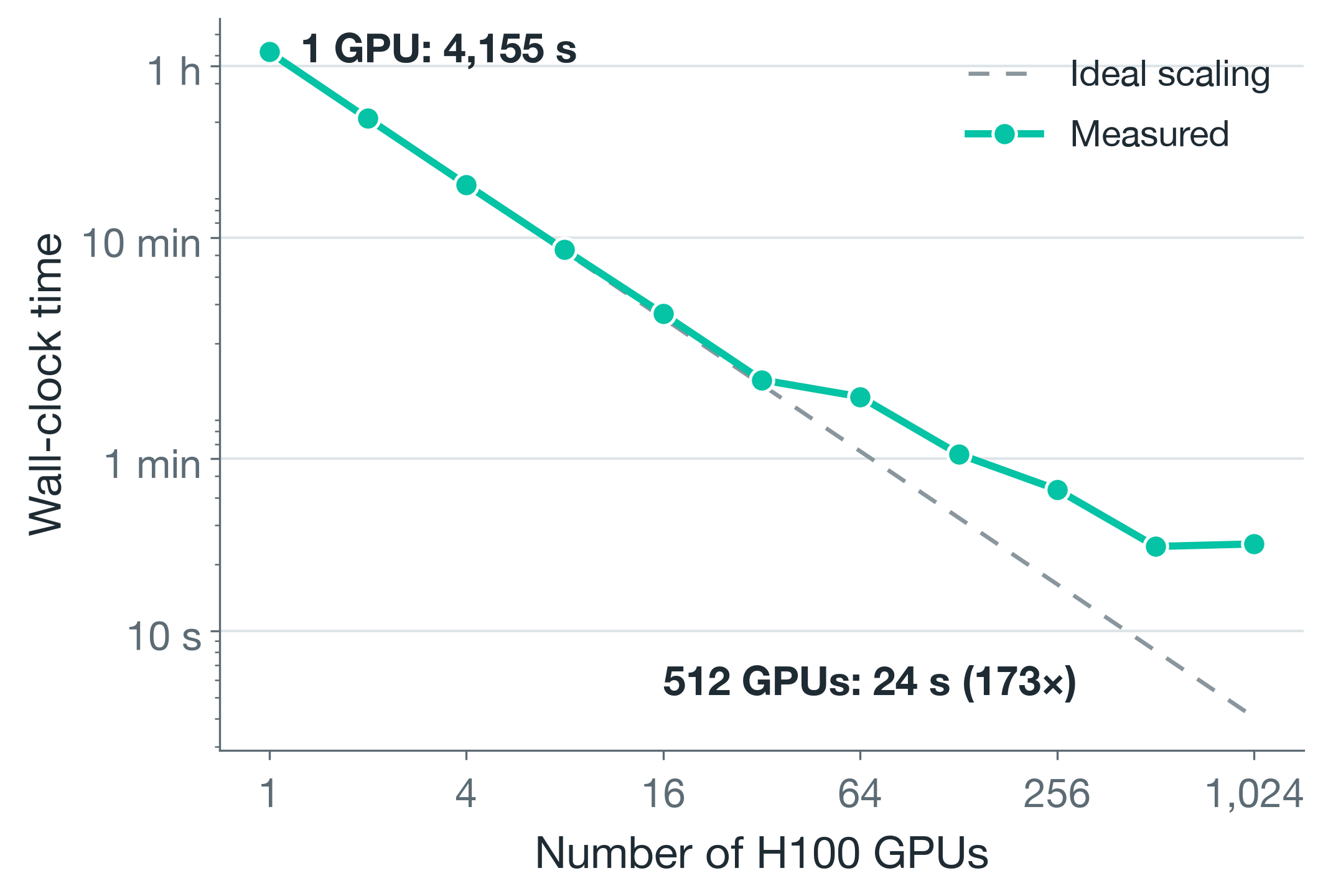
Figure 3: Execution time as the number of GPUs used for the same computation increases (strong scaling). The solid green line shows measured performance, and the gray dashed line shows ideal scaling, in which doubling the GPU count halves the execution time.
Future Outlook
Validation of the entire qubitization-based QPE workflow, from circuit construction and compilation to multi-GPU simulation and measurement analysis, confirmed results within chemical accuracy. It suggests that reference data for comparison with future validation on quantum hardware can be obtained in advance.
Expanding the range of molecules and quantum circuits that can be validated through classical simulation will require more efficient representations of molecular models and advances in software for handling large quantum circuits with limited computing resources. QunaSys will continue to pursue larger-scale, more accurate validation through advances in both quantum algorithms and simulation technology. Through this research and development, QunaSys aims to improve the reliability of algorithms for future fault-tolerant quantum computers and build a technological foundation for applying quantum computing to quantum chemistry and other industrial fields.
Research Support
This research used computing resources on AIST’s quantum-classical hybrid computing infrastructure, ABCI-Q, provided through the ABCI-Q Grand Challenge program. The study also used quri-parts-cuquantum, software for multi-GPU simulation developed jointly with AIST under the Cross-ministerial Strategic Innovation Promotion Program (SIP).
About QunaSys Inc.
QunaSys develops algorithms and software for industrial applications of quantum computers. Through quantum technology research and development and support for companies adopting these technologies, QunaSys is working to bring quantum computing into practical use.